Women in the Islamic discourse, between traditionalism and perspectives of an internal reform


Presently and somewhat stereotypically, there exist two types of discourses which are articulated around the question of Women in Islam. These two discourses reflect two opposing perceptions and place themselves within a framework of perpetual confrontation.


Firstly, we have the discourse which I would call "traditionalist", predominantly found within Muslim societies and which, in spite of its tendencies to call for a "renewal" of Islam as a way of life, remains reluctant to evolve on the question of women.


The other discourse, to the antipode of the traditionalist type, is one which crystallizes all the failures of the Muslim world on religious questions thereby demanding a "women’s liberation’’ from religious oppression, the latter being obviously responsible for all those failures.


 Unfortunately, we note that between those who promulgate an eradication and a complete break with the religious references - considered to be representative of the underdeveloped and the reactionary legal status of women - and those who comfort their positions within a fixed traditionalism and a strictly literal interpretation of the texts, it is first and foremost the say of the women themselves that ends up deliberately confiscated.


One can easily be apalled by the number of prejudices and stereotypes which prevent any attempt of dialogue between the supporters of these two types of discourse. To make any sense of this, it is necessary distance oneself from these two extreme visions so as to better comprehend where they come from and what exactly justifies their respective analyses?


Following the example set by the newly prevailing Islamophobia, the ‘eradicative’ vision   benefits from a potently suggestive statement: that the pathetic state of Muslim societies – with the legal status of woman acting as a strong indicator of how far behind these nations are in respect to an indecently prosperous West – constitutes the ideal gap through which the whole system of an ethnocentric ideology is going to enter and to discredit Islam and its social values.


The traditionalist vision stays, for its part, under the influence of an entirely defensive and reactive discourse which answers to a “dominant – dominated” dialectic. The supporters of this discourse refuse any reform of the status of women because women have always been considered, according to the point of view of a certain Islamic jurisprudence, as the "moral guarantee" underpinning a whole system of moral values. Thus, according to this particular vision, any idea of reform is perceived as being an imported, westernized and dangerously immoral idea…While protecting itself from an ideology which remains hegemonic on a political level, this Islamic vision prefers giving support to a flagrant discrimination towards women, rather than accepting the western injunctions which are perceived as a form of ‘acculturation’ .


These two antagonistic visions end up submitting the Muslim woman to an intolerable dilemma, namely, to choose between two ‘alienations’.  The first one is to deny her roots or even to "disintegrate" within a “universal abstract” and "become westernized"[1] in order to be liberated from a supposedly oppressing Islamic reference. The second one is to retreat into a hermetic Islamic identity where she is refused those basic or even legitimate rights which are normally granted to her by Islam itself.


It is between these two extreme visions that it is necessary to search for a third way that, alone, can help liberate us from these two kind of alienations. A third way which may fill up the moral, ethical and spiritual void of the complex modernity we have so mush trouble living in.


We have an urgent need of an internal reform. A reform which nourishes itself from spiritual Islamic references whilst staying open to those universal values that we must learn to share with the rest of the humanity.


The "back to the sources" idea advocated by Muslims disappointed by their present  should not mean imprisonment within a historical and overly idealized past expressed and reflected in the Islamic discourse prevailing today . Rather, the "back to the sources" idea refrain from adhering to archaic models and seek, instead to stay true to universal and ethical principles which are not at all incompatible with Islamic values.   


To be continued….


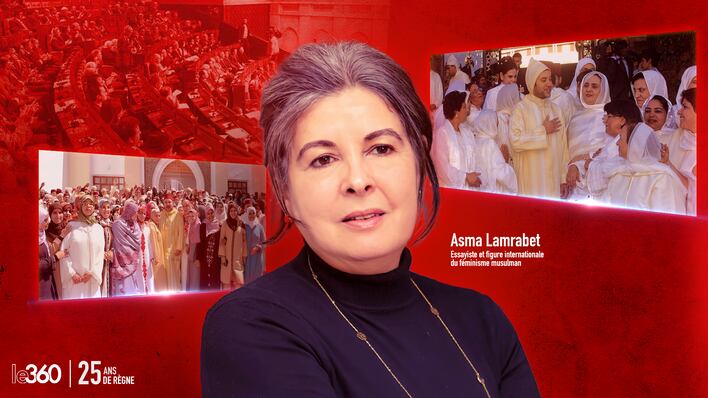
Asma Lamrabet


[1] I adhere to the definition of « westernized » as it has been formulated by Bourhan Ghalioune in his book entitled Islam and Politics – Modernity betrayed: “the westernized is not a westerner but its opposite; an individual who makes of  his adherence to a dominant culture a criteria of distinction and of quasi-ethnical discrimination!”